The Giant Flare of 2004 December 27 from SGR 1806-20
Abstract
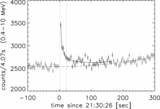
The giant flare of 2004 December 27 from SGR 1806-20 represents one of the most extraordinary events captured in over three decades of monitoring the γ-ray sky. One measure of the intensity of the main peak is its effect on X- and γ-ray instruments. RHESSI, an instrument designed to study the brightest solar flares, was completely saturated for ~0.5 s following the start of the main peak. A fortuitous alignment of SGR 1806-20 near the Sun at the time of the giant flare, however, allowed RHESSI a unique view of the giant flare event, including the precursor, the main-peak decay, and the pulsed tail. Since RHESSI was saturated during the main peak, we augment these observations with Wind and RHESSI particle detector data in order to reconstruct the main peak as well. Here we present detailed spectral analysis and evolution of the giant flare. We report the identification of a relatively soft fast peak just milliseconds before the main peak, whose timescale and size scale indicate a magnetospheric origin. We present the novel detection of emission extending up to 17 MeV immediately following the main peak, perhaps revealing a highly extended corona driven by the hyper-Eddington luminosities. The spectral evolution and pulse evolution during the tail are presented, demonstrating significant magnetospheric twist during this phase, but no apparent magnetospheric evolution. Blackbody radii are derived for every stage of the flare, which show remarkable agreement despite the range of luminosities and temperatures covered. Finally, we confirm the existence of a hard afterglow emission extending up to 2.5 MeV in the hundreds of seconds following the giant flare.
- Publication:
-
The Astrophysical Journal
- Pub Date:
- May 2007
- DOI:
- 10.1086/516732
- arXiv:
- arXiv:astro-ph/0611318
- Bibcode:
- 2007ApJ...661..458B
- Keywords:
-
- Gamma Rays: Observations;
- Stars: Pulsars: Individual: Alphanumeric: SGR 1806-20;
- Stars: Neutron;
- Astrophysics
- E-Print:
- 32 pages, 14 figures, submitted to ApJ